
The following peer-reviewed studies were presented during advanced coursework at Chi University in the course Advanced Traditional Chinese Veterinary Medicine Approach to Neurological Disorders in Small Animals.
These publications illustrate molecular, cellular, and clinical effects of electro-acupuncture (EA) in experimental and clinical spinal cord injury models. They are provided here for educational reference.
Molecular & Cellular Mechanisms (Experimental Models – Rats)
These studies demonstrate how EA works at the cellular level.
Li et al., 2010 – Neuroscience Research (See Reference 1 Below)
- Increased ANXA5 and CRMP2
- Enhanced neuroprotection and axonal regeneration
- Governing Vessel (GV-6, GV-9) superior to Hua-Tuo-Jai-Ji
Ding et al., 2009 – BMC Neuroscience. (See Reference 2 Below)
- Stem cell mobilization (MSCs)
- Increased NT-3 and cAMP
- Enhanced differentiation and nerve repair
Xie et al., 2006 – Journal of Traditional Chinese Medicine (See Reference 3 Below)
- Reduced aquaporin-4 (AQP4) expression
- Potential reduction of spinal cord edema
Nesic et al., 2006 – Neuroscience Research
- Acute and chronic AQP4 modulation after injury
Clinical Trials – Intervertebral Disc Disease (Dogs)
This is where things get clinically meaningful for families with intervertebral disc disease. Clinical trials indicate that electro-acupuncture gives better results.
Journal of the American Veterinary Medical Association (Hayashi & Matera, 2007) ( See Reference 6 Below)
- 50 dogs (RCT)
- Faster ambulation in Grade 3–4 dogs with EA
- 50% recovery of deep pain in Grade 5 dogs (vs 12.5% prednisone alone)
That statistic alone is compelling.
Joaquim et al. – IVDD Severe Deficits Study. (See Reference 7 Below)
40 dogs (Grade 4–5). Recovery rates:
- EA alone: 78.9%
- EA + surgery: 72.2%
- Surgery alone: 40%
Surgical outcomes are best within 24 hours of injury. When surgery is delayed or not possible, EA appears to improve outcomes.
Han et al., 2010 – American Journal of Chinese Medicine. (See Reference 8 Below)
80 paraplegic dogs in the study. Prednisone + EA:
- Faster pain relief
- Faster recovery
- Lower relapse rates
Cervical Myelopathy (Wobbler’s Syndrome)
Sumano et al., 2000. (See Reference 9 Below)
Success rates:
- Surgery alone: 20%
- Surgery + EA: 85%
That is very very significant!
Combination Therapy Evidence
Yang et al., 2003 – Journal of Veterinary Science (Sir Reference 10 Below)
Four groups:
- Corticosteroids
- EA
- Corticosteroids + EA
- No treatment
Combination therapy recovered significantly faster than all others. This supports integrative medicine — not replacement medicine. For those who wish to review the primary literature, full citations are listed below.
These studies were not performed by Dr. Denette Cooke or The Cooke Veterinary Medical Center. They are presented for educational and reference purposes to support evidence-based integrative veterinary medicine.
References and Study Overviews
Reference 1 – Li WJ, Pan SQ, Zeng YS et al.
Li WJ, Pan SQ, Zeng YS et al. Identification of acupuncture-specific proteins in the process of electro-acupuncture (EA) after spinal cord injury. Neuroscience Research 2010; 67: 307-316. A study done in rats with damaged spinal cords.
The neural specific-proteins Annexin-A5 (ANXA5) and collapsing response mediator proteins-2 (CRMP2) are known to be beneficial to neuronal survival and axonal regeneration.
ANXA5 and CRMP2
- Significantly increased the group received electro-acupuncture at GV-6 and GV-9 (known as Governing Vessel) as compared to the control receiving non-acupoint electrical stimulation group.
- Other proteins in the spinal cord associated with inflammation, cell adhesion, cell migration, signal transduction and cell apoptosis were also altered significantly to favor neuroprotection and regeneration in the group receiving EA at GV-6 and GV-9.
- Additional ANAXA5 and CRMP2 was higher in rats receiving EA at GV-6 and GV-9 than those receiving EA at Hua-Tuo-Jai-Ji (HTJJ). Hua-Tuo-Jai-Ji are lateral points that have been traditionally used in EA in spinal cases. This indicated that in the parameter of neuroprotection, EA of GV acupoints may be superior to EA at HTJJ points.
Reference 2 – Ding et al.
Ding et al. Electro-acupuncture promotes survival, differentiation of bone marrow mesenchymal stem cells as well as functional recovery in the spinal cord-transected rats. BMC Neuroscience 2009; 10:35
Electro-acupuncture at GV-6 and GV-9, GV-1 and GV-2 in rats with T-10 spinal cord transection once every other day for 7 weeks using 60 Hz for 20 minutes.
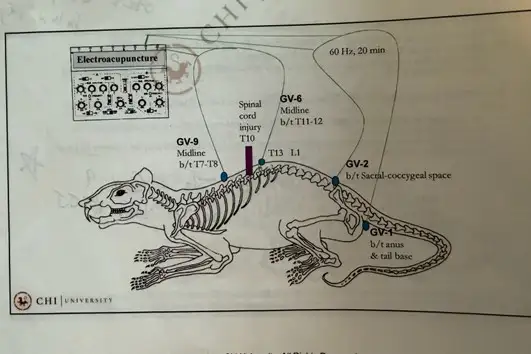
- Released mesenchymal stem cells (MSCs)
- Enhanced nerve regeneration and protecting the nerves in the lesion and nearby tissues was found in the treatment group compared to control group
- Neruotrophin-3 (NT-3), cyclic adenosine monophosphate (cAMP), differentiated MSCs increased in the treatment group vs. the control group.
Reference 3 – Xie J, Fang J, Feng X. Et al.
Xie J, Fang J, Feng X. Et al. Effect of electro-acupuncture at acupoints of the governing vessel on aquaporin-4 in rat with experimental spinal cord injury. Journal Traditional Chinese Medicine 2006; 26; 148-152
- Aquaporin-4 (AQP4) is increased by insults to the central nervous system tissues.
- EA GV-4 and GV-14 at 20 Hz for 20 minutes in a rat with spinal cord injury at T-10 significantly reduced the expression of AQP4 in rats with spinal cord injury compared to controls.
Reference 4 – Nesie O, Lee J, Ye Z. Et al.
Nesie O, Lee J, Ye Z. Et al. Acute and chronic changes in aquaporin-4 expression after spinal cord injury. Neuroscience Research 2006; 143: 779-792
A similar study to the above on AQP4.
Reference 5 – Tangjitjaroen W
Tangjitjaroen W, Acupuncture for the treatment of spinal cord injuries. American Journal of Traditional Chinese Veterinary Medicine 2011; 6(2) 37-43.
Reference 6 – Hayashi AM and Matera JM
Hayashi AM and Matera JM, Evaluation of electroacupuncture treatment for thoracolumbar intervertebral disk disease in dogs. Journal of the American Veterinary Medical Association 2007; 231(6):913-918
50 dogs with IVDD in Randomized Control Trials (RCT)
- Grade 1 = pain only
- Grade 2 = ataxia and mild paraparesis
- Grade 3 = non-ambulatory paraparesis
- Grade 4 = paraplegia with deep pain
- Grade 5 = paraplegia with no deep pain
All dogs treated with tapering doses of prednisone steroid anti-inflammatory. The EA group also received EA weekly or biweekly (Grade 5 dogs).
Results:
- The time to recover ambulation in 7 dogs with Grade 3 and 4 deficits with EA was significantly less than the 9 dogs similarly affected dogs not receiving EA.
- Deep pain perception of dogs with Grade 5 dysfunction was regained in EA dogs at 50% (3 out of 6) where with prednisone alone 12.5% (1 out of 8 patients).
Reference 7 – Joaquim JG, Luna SP, Brondani JT et al.
Joaquim JG, Luna SP, Brondani JT et al. Comparison of decompression surgery, electroacupuncture, and decompressive surgery followed by electroacupuncture for the treatment of dogs with intervertebral disc disease with long standing severe neurological deficits.
40 dogs with IVDD in a Randomized Control Trials (RCT). 40 dogs had Grade 4 or 5 neurological deficits due to IVDD. All dogs received conventional treatment of tapering dose of prednisone, but were also treated with either surgery, surgery plus EA, or EA alone.
Recovery rate results (Grade 4 or 5 becoming 1 to 2 within 6 months):
- EA alone: 78.9% (15 out of 19)
- EA plus surgery: 72.2% (8 out of 11)
- Surgery alone: 40% (4 out of 10)
Conclusion:
If early surgical intervention (within 24 hours) was not possible, dogs with Grade 4 and 5 neurological deficits may benefit from tapering prednisone and electroacupuncture. This study indicates that surgery outcomes are best within 24 hours of the injury.
Reference 8 – Han HJ, Yoon HY, Kim JY et al.
Han HJ, Yoon HY, Kim JY et al. Clinical effect of additional electroacupuncture on thoracolumbar intervertebral disc herniation in 80 paraplegic dogs. American Journal of Chinese Medicine 2010; 38(6): 101-105
80 paraplegic dogs with intact deep pain associated with IVDD. Randomized Controlled Trials (RCT). All dogs received prednisone. Back pain relief and recovery (ambulation) times and recovery and relapse rates were compared for a group receiving prednisone alone (n=37) and a group receiving prednisone plus EA (n=43).
Dogs receiving prednisone plus acupuncture had:
- a significant shorter time for pain relief and recovery
- a better overall rate of recovery and fewer relapses than dogs treated with prednisone alone.
Reference 9 – Sumano H, Bermudez E, Obergon K.
Sumano H, Bermudez E, Obergon K. Treatment of Wobbler Syndrome in dogs with electroacupunture. Deutsche Tierarztliche Wochenschrift 2000; 107(6): 231-5.
40 dogs with Wobbler’s Syndrome (cervical spondylomyelopathy) Randomized Controlled Trials (RCT). Dogs were graded based on the severity of their neurological deficits and then randomly assigned to one of two groups to ensure equal overall severity between groups.
- Group 1 (n=20 dogs) surgery and conventional medicine
- Group 2 (n=20 dogs) electroacupuncture with or without surgery and conventional medicine
Overall success rates:
- 20% in Group 1 with surgery, conventional medicine
- 85% in Group 2 with surgery, conventional medicine and EA
Reference 10 – Yang JW, Jeong SW, Seo KM et al.
Yang JW, Jeong SW, Seo KM et al. Effects of corticosteroids and electroacupuncture on experimental spinal cord injury in dogs. Journal of Veterinary Science 2003; 4(1) 97-101
20 paraplegic dogs with preserved deep pain, Randomized Controlled Trials (RCT). 20 paraplegic dogs with preserved deep pain were divided into four treatment groups and recovery time was monitored using only neurological examinations and somatosensory evoke potentials.
Four groups were:
- only corticosteroids
- only electroacupuncture (EA)
- a combination of corticosteroids and EA
- no treatment
Results:
Groups receiving only corticosteroids or EA recovered significantly faster than the group receiving no treatment, but were not significantly different from each other. The group receiving a combination of corticosteroids and EA recovered significantly faster than all other groups.